

The Quantum Shadow
We live in a world that often feels defined by what we fear. It’s the silent protagonist in the drama of our lives, pulling the strings of our decisions, whispering doubts into our ears, and erecting invisible walls around our potential. But what if the very thing we call “fear” is not a force of its own, but merely the absence of something else? What if it is a quantum shadow, a distortion of reality cast by a momentary lapse in our awareness?
This exploration of fear will not follow the well-trodden path of mainstream psychology. Instead, we’ll dive into a more progressive, free-thinking perspective, drawing from the wisdom that suggests our reality is less about what we see and more about the frequencies we tune into. In this view, fear is not a concrete enemy to be battled, but an illusion to be seen through—a misperception of a reality that is fundamentally whole and loving.
The True Nature of Fear: A Misperception of Reality
Mainstream thought often defines fear as a basic, survival-oriented emotion. We are taught to manage it, control it, or confront it. But this framework treats fear as a given, a solid piece of the human condition. What if this is a fundamental misunderstanding?
As articulated in the profound teachings of A Course in Miracles, fear is not the opposite of courage. It is, quite simply, the opposite of love. This is a distinction of cosmic importance. Love, in this context, isn’t a sentimental emotion; it is our true, unified state of being. It is the creative, connective force that binds all things. Fear, then, is the belief that this connection is severed. It is the ego’s grandest illusion: the idea of separation.
Think of it like light and dark. Darkness is not an independent entity; it is merely the absence of light. You don’t “fight” the darkness; you simply introduce light, and the darkness vanishes. Similarly, fear is the absence of love. When we believe we are separate—from each other, from our source, from our inherent worthiness—we experience the symptoms of fear. Every anxious thought, every moment of doubt, every feeling of inadequacy is a symptom of this core, quantum misperception. We are convinced we are alone, vulnerable, and incomplete, when in fact, our essential nature is pure, unbroken connection.
The Subtle Whispers of the Shadow: Signs We Don’t Recognize as Fear
The most dangerous aspect of fear is its masterful disguise. We rarely recognize it for what it is. We often mistake its manifestations for personality traits, work ethic, or just “the way things are.” These are the subtle whispers of the shadow, and learning to identify them is the first step toward seeing through the illusion.
- Procrastination: You have a brilliant idea or a crucial task, but you endlessly postpone it. This isn’t laziness; it’s the fear of failure, the fear of success, or the fear of being judged. The shadow whispers, “If you don’t start, you can’t fail.”
- Perfectionism: The need for everything to be flawless before it’s released to the world. This is not a quest for excellence; it is the fear of criticism and the deep-seated belief that your worth is tied to a perfect outcome.
- People-Pleasing & Over-Commitment: Saying “yes” when you desperately want to say “no.” This isn’t generosity; it’s the fear of rejection or the fear of conflict. You are afraid that if you set boundaries, you will lose love or acceptance.
- Gossip & Judgment: The act of critiquing or judging others. This is a manifestation of the fear of your own inadequacy. By finding fault in others, the ego attempts to elevate itself, creating a false sense of superiority to avoid looking at its own perceived flaws.
- Controlling Behavior: The need to micromanage people and outcomes. This is the fear of unpredictability and chaos. The shadow convinces you that if you just control every variable, you can prevent a dreaded outcome.
- Chronic Indecision: Being paralyzed by choices, both big and small. This is the fear of making the “wrong” choice, the fear of regret, and the fear of taking responsibility for the path you create.
The Debilitating Influence: How Fear Cripples Our Lives
Once we recognize these subtle signs, we can begin to see the immense power fear has to debilitate every aspect of our existence, both private and public. It acts as an energetic anchor, preventing us from rising to our full potential.
In our private lives, fear sabotages the very connections we crave. It manifests as a lack of emotional intimacy because we are afraid to be truly seen. We build walls around our hearts to “protect” ourselves, but in doing so, we trap ourselves in a cage of our own making. Fear of abandonment leads us to push people away before they can leave. Fear of vulnerability prevents us from having difficult but necessary conversations, leading to resentment and disconnection. It keeps us in comfort zones, stagnant in our growth, and unwilling to explore the depths of our own consciousness.
In our business lives, fear is the primary obstacle to innovation and leadership. It is the imposter syndrome that prevents a brilliant person from speaking up in a meeting. It is the risk aversion that causes a business to stagnate rather than pivot and thrive. Fear of failure keeps us from launching that new product, investing in that new idea, or asking for that promotion. It keeps us from delegating, because we fear no one can do it as well as we can—a fear rooted in the belief that our worth is tied to our constant, exhaustive effort. A leader operating from a place of fear creates a culture of distrust and rigidity, whereas a leader operating from a place of love inspires creativity, trust, and resilience.

The Great Unraveling: 10 Solutions to Overcome Fear
To overcome fear is not to become a superhero who feels nothing. It is to become a master alchemist, transforming the shadow into light. It is a conscious, step-by-step journey of unraveling the illusion and remembering who we truly are.
- Acknowledge and Witness the Shadow. The first step is simple presence. Instead of resisting a fearful thought, just observe it. See it for what it is: a fleeting thought, a vibration, a story the ego is telling. Say to yourself, “I am witnessing a thought of fear,” rather than, “I am afraid.” This creates a crucial space between you and the illusion.
- Practice Conscious Breathing. When fear takes hold, it often manifests as a shallow, rapid breath. Consciously slow down your breathing. Inhale for a count of four, hold for four, and exhale for four. This simple act sends a signal to your nervous system that you are safe, grounding you in the present moment where fear cannot exist.
- The Quantum Reframe. Every fearful thought is a signal pointing to where love is needed. Instead of seeing the fear of public speaking as a reason to avoid it, reframe it. See it as an opportunity to practice self-love, to trust your voice, and to connect with others. The fear is the guidepost, not the barrier.
- Embrace Radical Vulnerability. Share your fears with a trusted confidant, a partner, or a mentor. Speaking your fear aloud immediately diminishes its power. The ego thrives in secrecy and shame. By bringing your fear into the light of connection, you dissolve the illusion of separation that gave it life.
- Re-script Your Inner Narrative. We are constantly telling ourselves stories. The ego’s story is often one of lack and limitation. Begin to consciously replace that story with a new one. When a thought of “I’m not good enough” arises, replace it with “I am worthy of growth and expansion.” It may feel forced at first, but with repetition, you are literally rewiring your brain.
- Channel Fear into Creative Expression. The energy of fear is intense. Instead of letting it paralyze you, channel it. Write, paint, sing, or dance. Give the fear a form, and in that act of creation, you will find its energy transmutes into something beautiful and meaningful.
- Take Micro-Actions. Don’t wait until you’re “not afraid” to act. Take the smallest possible step in the presence of the fear. If you’re afraid to launch a new business, the micro-action might be simply writing down a name for it. Each small act of courage builds momentum and diminishes the perceived power of the shadow.
- Mindful Movement. Engage your body. Go for a walk, practice yoga, or stretch. Fear is often a trapped, frozen energy. Moving your body releases this energy and helps you reconnect with your physical self, pulling you out of the anxious thought loops of your mind.
- Practice Gratitude and Generosity. Fear is inherently self-focused. It centers on what you lack or what you could lose. Shift your focus by actively practicing gratitude for what you have and by giving your time or energy to others. The act of giving is an act of love, and love, by its very nature, dispels fear.
- Surrender to the Flow. The ego’s greatest fear is loss of control. The final solution is to surrender this need. Trust that the universe is not working against you. Surrender is not passive resignation; it is an active, courageous choice to release the illusion of control and flow with the greater current of life.
Tools for the Journey
As you embark on this path, there are simple tools that can aid you in the process of grounding and self-reflection. These are not solutions in themselves, but helpful companions on the journey to remembering your true nature.
- A High-Quality Journal: A physical notebook is a sacred space for your thoughts. Use it to practice your conscious re-scripting, to witness your fearful thoughts, and to track your micro-actions.

- Essential Oils & Diffuser: Scents like lavender, frankincense, or bergamot can have a powerful effect on your nervous system. A simple diffuser can create a calming environment, making it easier to practice conscious breathing and meditation.

- A Comfortable Meditation Cushion: Creating a dedicated space for your practice is essential. A comfortable cushion can make it easier to sit for extended periods, encouraging consistency in your grounding and presence work.

- Mindful Breathing and Meditation Apps: For those just starting, guided meditations can be invaluable. They provide the structure and verbal cues to help you calm your mind and focus on your breath.
Mindsight ‘Breathing Buddha’ Guided Visual Meditation Tool for Mindfulness

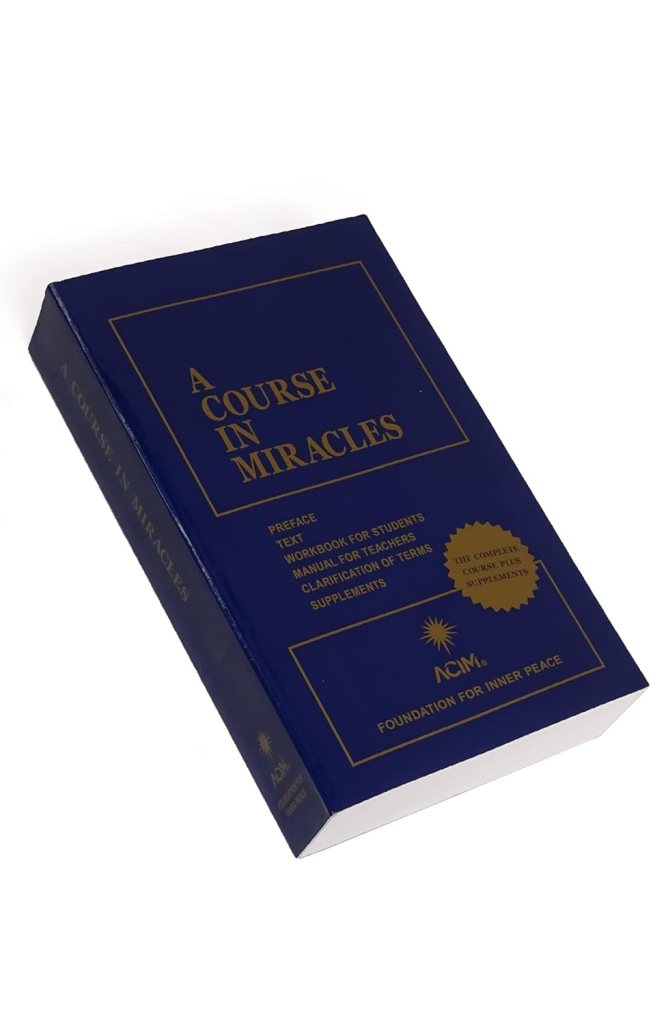
Only for the bravest ones – For those already on the path, ready to dive much deeper: A Course in Miracles: Combined Volume
By understanding fear not as an opposing force, but as a quantum shadow—a specific vibrational frequency arising from a momentary imbalance—we begin to perceive it as a crucial signal. It’s an energetic pointer, guiding us with precision back to our true state of perfect harmony. This journey isn’t about the endless pursuit of an idealized emotion like ‘love’ or the futile effort to banish ‘fear.’ Such dualistic thinking keeps us tethered to a pendulum swing, forever seeking one pole while avoiding the other.
Instead, the path before us is about cultivating a profound, balanced awareness—a consciousness vast enough to recognize and encompass all experiences without judgment. When fear arises, we learn to witness it, not as an enemy, but as a passing frequency within the infinite spectrum of being. We integrate it, understanding its temporary nature, allowing it to simply exist without disrupting our core equilibrium. Our essential nature isn’t defined by extremes; it is this unwavering, unifying consciousness—a vast, harmonious field where every sensation, thought, and emotion, including what we label as fear, are simply recognized as transient patterns within an unchanging, perfectly balanced presence. This is the true liberation: not from fear, but from the belief that we are separate from our own inherent wholeness and peace.
As you navigate this profound inner landscape, what practices are you embracing to guide your own journey toward this balanced presence?
 Astra Aeternum X
Leave a comment