
Your Smartphone Is Making You Dumber, Anxious, and Exhausted, And You Already Know It

You’ve felt it. That hollow, slightly sick feeling after an hour of scrolling. The way your attention has gotten shorter. The way you reach for your phone before you even know why. You don’t need a study to tell you something is wrong, your body already knows.
But here’s the thing nobody talks about: the problem isn’t you. It’s not a willpower problem. It’s not a discipline problem. You’re not weak. You’re just outgunned.
The apps on your phone were built by some of the smartest engineers on the planet, armed with behavioral psychology, billions of data points, and one singular goal: to make you unable to stop. Infinite scroll, variable reward loops, notification anxiety, the compulsive check, these aren’t accidents. They’re features. And they’re running 24/7 against a brain that evolved to scan the horizon for predators, not parse an endless feed of outrage and highlight reels.
A digital detox isn’t a wellness trend. It’s something more fundamental than that. It’s the act of reclaiming your own mind.
What Actually Happens When You Log Off
The research on digital detox is still young, but what we have is telling. Studies on reduced social media use show meaningful drops in anxiety and stress within days, not weeks. People sleeping through short detox periods logged around 20 extra minutes of sleep per night on average. That doesn’t sound like much until you run the math: that’s over two extra hours of sleep per week your phone has been quietly stealing from you.
Blue light from screens suppresses melatonin, the hormone your brain uses to know it’s time to sleep. But it’s not just the light. It’s the mental state: the unresolved arguments you read, the news cycle that never ends, the comparison spiral of watching everyone else’s curated life. Your nervous system goes to bed activated, and it shows up the next day irritable, foggy, and reaching for the phone again to feel something. The cycle feeds itself.
What people consistently report after even a few days of reduced digital use is striking in its simplicity: they feel calmer. They notice more. They’re actually present in conversations instead of half-present while mentally composing their next caption. The world gets a little more textured and a little less urgent.
This isn’t nostalgia for some pre-internet golden age. This is your brain returning to baseline.
Why Willpower Is the Wrong Tool
Here’s where most digital detox advice fails you. It tells you to “be more intentional” or “set limits” and then sends you back to the same device, with the same apps, running the same algorithms. That’s like telling someone to drink less while keeping a bottle on their desk.
The smartphone as we know it is an entertainment machine first and a communication tool second. Its entire interface, the large glassy screen, the swipe mechanics, the app ecosystem, is optimized for consumption, not for living. And you carry it everywhere, all the time, which means the temptation never fully disappears. Willpower is a finite resource. Eventually, you’ll check.
This is why the most interesting conversation in tech right now isn’t about apps or screen time settings. It’s about the device itself.
There’s a generational twist to this story that nobody saw coming. Gen Z, the generation that grew up with smartphones glued to their hands, is quietly leading a retro rebellion. Thrift stores and eBay listings for old BlackBerries, Nokia bricks, and early 2000s flip phones are seeing a genuine resurgence, driven largely by younger people who are exhausted by the always-on, always-performing nature of modern smartphone life. They’re not doing it ironically. They’re doing it because a phone that can only call and text is a phone that can’t trap you. I get it.
I’m there too, I’m done with my iPhone! We’ve built an entire social hierarchy around a rectangle. Having last year’s iPhone isn’t just outdated anymore, it’s a status signal, a scarlet letter that says you couldn’t keep up. People genuinely look down on a cracked screen or an older model the way previous generations judged a worn-out car or an off-brand outfit. We got played into making a trillion-dollar corporation’s annual upgrade cycle into a personality trait. The thing has been a slot machine in my pocket for years, and I’m ready to trade the dopamine lottery for something that actually serves me instead of harvesting me. The question isn’t whether to make a change. It’s what to replace it with.
A Different Kind of Phone
A quiet movement has been building for a few years now: people ditching the smartphone slab entirely, or at least supplementing it, with devices that are built around a different philosophy. Not “here’s everything, good luck” but “here’s what you actually need.”
The Light Phone II is the purest expression of this idea. An e-ink display, a handful of tools, calls, texts, music, podcasts, maps, and nothing else. No social media. No browser rabbit holes. No YouTube. People use it as a full-time phone or as a dedicated weekend device when they want to actually be somewhere instead of documenting that they were there. The Wisephone 2 follows a similar ethos, offering a curated app environment that keeps you functional without turning you into a scroll zombie.
These phones are not for everyone. Giving up a full smartphone requires trade-offs most people aren’t ready to make. But they represent a shift in thinking that matters: the idea that the best tool for mental health might be one that asks less of you, not more.
The Middle Ground: Phones That Nudge You Toward Intention
Not everyone is ready to go full monk mode. But there’s a middle path that’s been quietly gaining traction, and I just walked it myself.
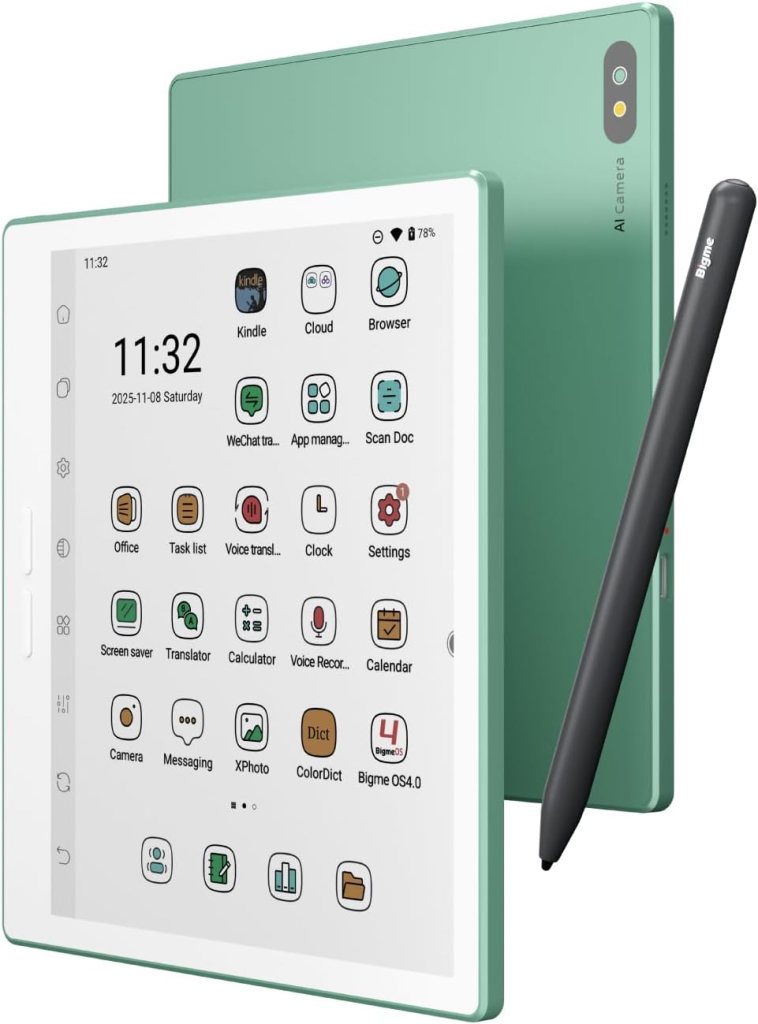
I ditched my iPad for a Bigme B7, a color ePaper tablet, and I love it! The e-ink screen is easier on my eyes, there’s no blue light wrecking my sleep, and honestly, the slight delay in the display just naturally slows me down (I tend to be squirrel-hyper). I stopped mindlessly tapping and scrolling. I am now much more intentional, and I’m actually reading.
The Bigme HiBreak takes that same philosophy and puts it in a phone. A 13-inch e-ink Android phone that runs apps but feels nothing like a smartphone. No glowing slab screaming for your attention. Just a calm, paper-like screen that makes doomscrolling feel like exactly the effort it isn’t worth.
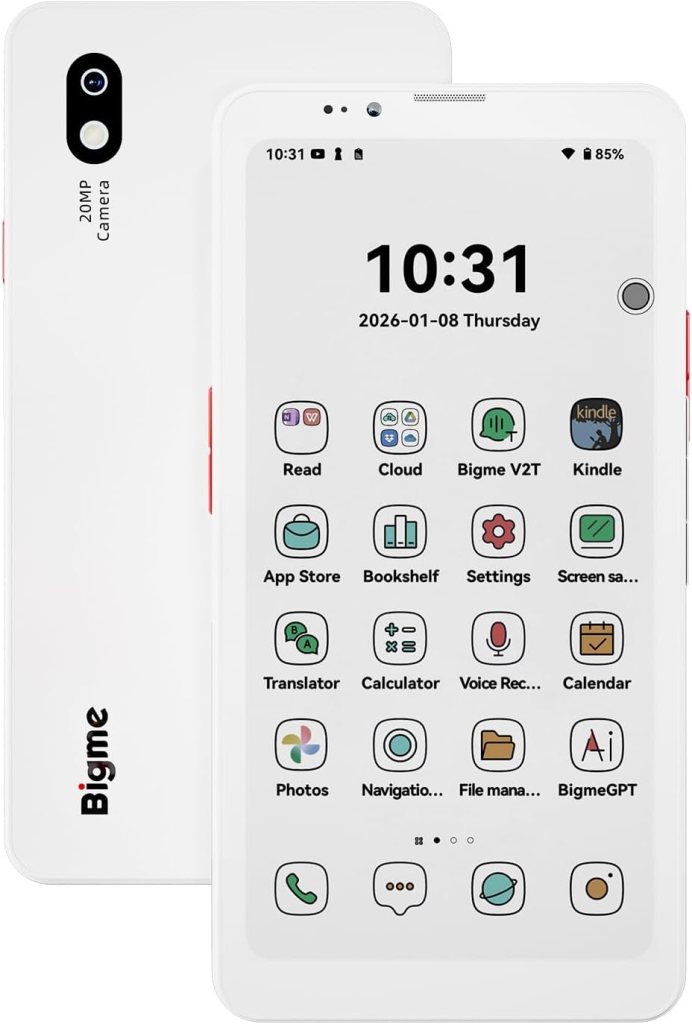
These aren’t phones for people who want to do less. They’re phones for people who want to think more clearly while they do it, be more aware and intentional.
Unihertz Titan 2 / Titan 2 Elite: The Productivity Detox Ally
The Unihertz Titan 2 looks like a phone from an alternate timeline where nobody decided the keyboard was unnecessary. It’s a rugged Android 15 device with a physical QWERTY keyboard, a compact 4.5-inch square display, 5G, 12GB of RAM, and 512GB of storage. The battery is 5050 mAh, which means it actually lasts through the day without becoming a source of anxiety in itself.
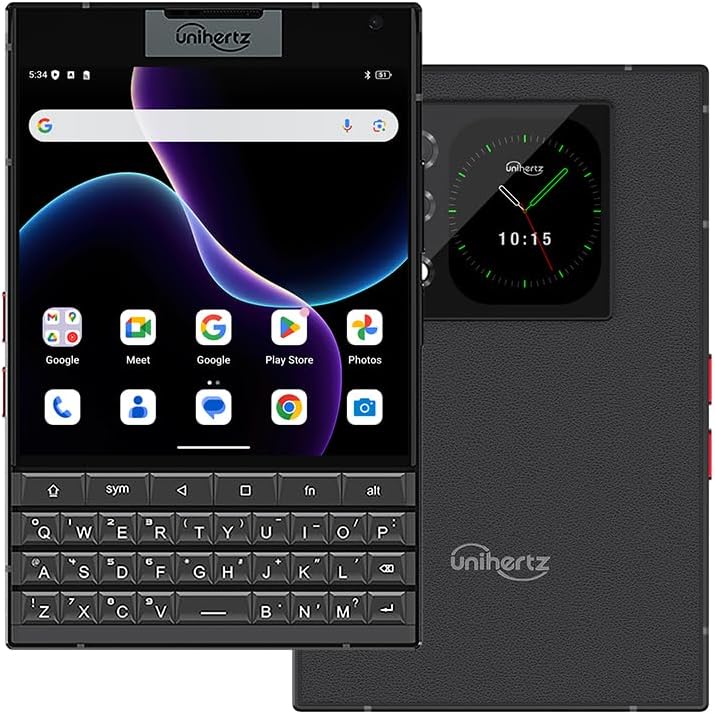
Here’s what makes it interesting for anyone trying to detox: the form factor itself works against doomscrolling. The small, square screen is genuinely awkward for TikTok or Instagram Reels. The keyboard layout signals to your hands and your brain that this is a device for doing things, not watching them. You’ll find yourself writing emails, sending actual messages, and using the built-in toolbox utilities. The experience nudges you toward participation instead of consumption.
The Titan 2 Elite, soon to be released, is the slightly more refined sibling, with the same keyboard-first philosophy, same rugged build, same fundamental belief that a phone should serve you rather than swallow you.
These aren’t perfect minimalist devices. You can still install whatever you want. But the design friction is real, and friction is exactly what compulsive behavior needs to break its grip.
Clicks Communicator: Communication Without the Consumption Trap
The Clicks Communicator takes a slightly different approach. It’s a keyboard-first Android 16 phone with a 4-inch OLED display, 5G, expandable storage, and, bless whoever approved this, a 3.5mm headphone jack. Clicks positions it explicitly as a “communication-first” device, and that framing matters more than it might seem.
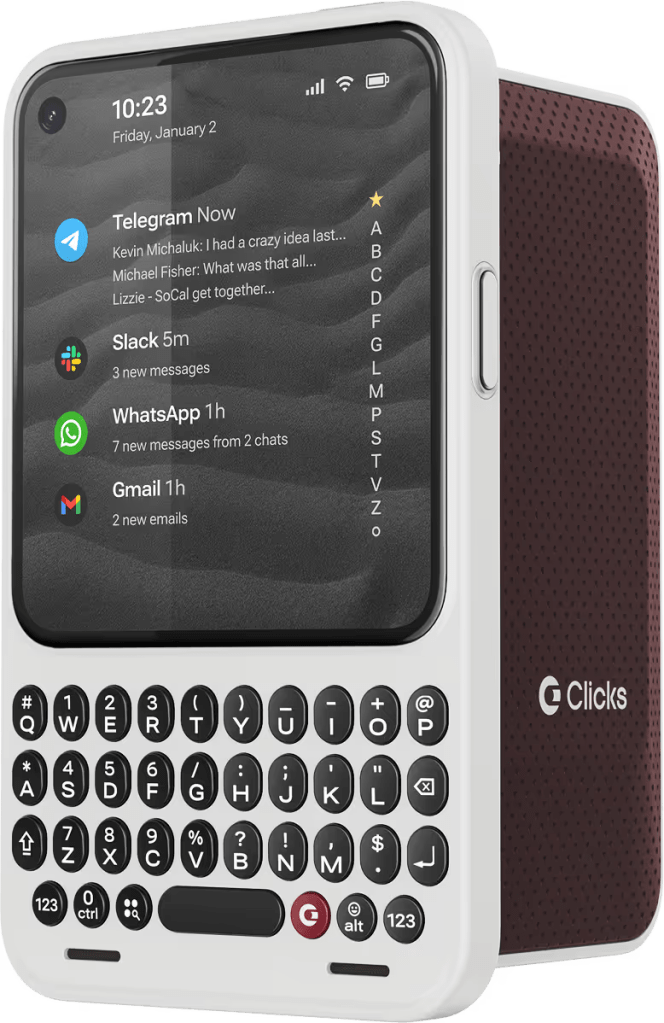
The phone’s notification LED is one of its smartest features. You can see at a glance whether something needs your attention without unlocking the device and tumbling into the feed. That single layer of friction between you and the screen is surprisingly powerful. Most of our compulsive checking isn’t about information, we need it’s anxiety discharge. Having a light that tells you “nothing urgent” breaks the loop before it starts.
Clicks also makes a Power Keyboard accessory that can turn your existing smartphone into a more intentional, keyboard-first experience while adding a built-in power bank. If you’re not ready to switch devices but want to shift the relationship, that’s an interesting entry point.

How to Actually Use These in a Detox Plan
Having the right device is a lever, not a solution. Here’s how to use it.
Use a minimalist or keyboard-first phone as a focus device. You don’t have to go all in. Try using it during your workday or on weekends while keeping your main phone in another room. The separation creates space. The different device creates a different mental mode.
Enforce app rules on the detox device. No social media. No news apps. No games that are just behavioral loops with graphics. Keep it to messages, maps, music, and maybe one or two apps you actually use for things that matter.
Build time windows, not bans. Checking messages twice a day at defined times is more sustainable than declaring you’ll never look at your phone again. The goal isn’t asceticism, it’s agency.
Replace the habit, not just the device. Your brain will look for something to do with the time and attention the phone used to consume. Have something ready. Paper books. Long walks without earbuds sometimes. Journaling. Calling someone instead of messaging them. Cooking a meal slowly. The analog replacements aren’t consolation prizes, they’re the point.
What It Means to Be Smart About Your Phone
We’ve spent a decade treating “smart” as a synonym for “capable of more.” A smarter phone does more things, connects to more services, serves more content. But there’s another definition of smart that we keep forgetting: appropriate for the task.
The smartest phone for your mental health might be the one you forget exists for hours at a time. The one that doesn’t demand anything from you. The one that you pick up because you want to use it, not because you felt a compulsive pull you can’t quite explain.
Start small. Try a no-phone hour before bed tonight. Try a weekend where you leave the main device at home and see what your keyboard phone can actually handle. You’ll be surprised. And more importantly, you’ll be present for whatever happens next, not documenting it from behind a screen, but actually in it.
The matrix, it turns out, is optional. You just have to decide to step out.
 Astra Aeternum X
Leave a comment