

Intense Spiritual Practices to Survive the AI Age
It started innocently enough, suddenly someone was writing those boring business emails for you, and you sounded so knowledgeable and so articulate, almost impressive. It was fun in the beginning, like discovering a superpower you didn’t earn but weren’t going to return either. But like most things that seem too good to be true, the ‘but’ appeared very quickly.
As we started going deeper, building automations, running analytics, doing research…, the waters got muddy. And that’s when we started noticing things: inconsistencies, untruths, flat-out lies delivered with the same calm, confident tone as everything else, with no hesitation. Yes, AI lied, and it was just wrong, beautifully, articulately wrong.
So we did what any reasonable person would do. We tried to reason with it. And we got the famous response: “You are correct. I apologize for the confusion. From now on I will…” And then it doesn’t. And you try again. And you get the exact same “You are correct…” Like talking to a golden retriever who keeps running even though you asked it to stay.
That’s when you want to pick up your laptop and throw it into the deepest ditch you can find. But you stop, take a breath, and you come back to your center. Because here’s my take on this AI age: the most important skill it’s forcing us to develop has nothing to do with prompts or tools or automation. It’s the ancient art of not losing your mind when it stops making sense. Although AI is assisting you, you are still at the helm; you have to be.
Florence Scovel Shinn knew something about that. Writing in the 1920s, long before anyone could have imagined arguing with a machine that politely lies to your face, she understood that the real battle was never out there. It was always in here, in the words you speak, the thoughts you feed, the inner world you either tend or abandon. She was right then. She’s more right now.
You stop anthropomorphizing it.
That’s the first and hardest one; we are wired for connection. We see faces in clouds and intentions in machines. When AI says “I understand,” something in us actually believes it does. It doesn’t. It’s pattern matching at a scale we can’t comprehend, dressed up in the language of empathy.
In The Game of Life and How to Play It, Shinn writes about the danger of giving power to external conditions: of letting the outside world dictate your inner state. AI is the ultimate external condition. Endlessly shifting, unreliable, occasionally brilliant, frequently maddening. The moment you stop expecting it to behave like a conscious being, the frustration vanishes. You wouldn’t scream at your dishwasher for not understanding how bad your day was, or would you?

You stay the author, not the audience.
AI is seductive because it produces constantly, effortlessly, and on demand. Slowly, without noticing, you can go from creator to consumer of your own work. Your voice starts sounding like everyone else’s, and your ideas arrive neatly pre-packaged.
Shinn was radical in her belief in The Power of the Spoken Word, that your words are creative forces, that what you speak and think actively shapes your reality. Let a machine speak for you long enough, and you start to forget what your own voice sounds like. The spiritual practice here is ruthless self-awareness, knowing when you’re steering and when you’ve handed over the wheel.
You protect your silence.
Most people don’t know that if you’re using AI all day, you are in constant cognitive conversation even when you think you’re just “checking something quickly” (your nervous system doesn’t know the difference)!
Silence, real silence, no input, no output, no screen time (beware of the black mirror!), is now a radical act. Meditation, walks without a podcast, or just sitting with your own thoughts without immediately asking something to organize them for you. That’s how you stay sane and where you stay you.
You remember what it can’t touch.
Your intuition, your lived experience, the way you know something is wrong before you can explain why, the grief that shaped you, the joy that surprised you creates that unique way you see the world that no dataset was ever trained on.
In Your Word is Your Wand, Shinn offers affirmations as anchors, simple declarations that return you to your own power when the world has pulled you away from it. In the AI age, we need them more than ever. Not as magical thinking but as conscious acts of remembering who you are when everything around you is trying to tell you that intelligence is something that happens on a server somewhere. It isn’t. Real intelligence, the kind that knows when to laugh, when to grieve, when to walk away from the laptop, that is still entirely yours.
And when all else fails, you laugh.
Because “You are correct, from now on I will…” followed immediately by doing the exact same thing again is genuinely, objectively funny. The absurdity of it is a gift if you let it be. Laughter is the fastest route back to your center.
And on the days when the frustration rises anyway, when you’ve had one too many “You are correct, from now on I will…” moments and you can feel yourself being pulled out of your own center: stop, breathe, and say:
“I now smash and demolish every untrue record in my subconscious mind. They shall return to the dust-heap of their native nothingness, for they came from my own vain imaginings.”
Florence Scovel Shinn wrote that long before any of this existed. And yet here it is, more useful than ever. Because the chaos was never really in the machine. It was in the moment I forgot that my mind creates my experience, not the other way around.
The AI will do what the AI does. And I will do what only I can do. Come home, right back to myself.
Florence Scovel Shinn Complete Collection Of All 5 Works:
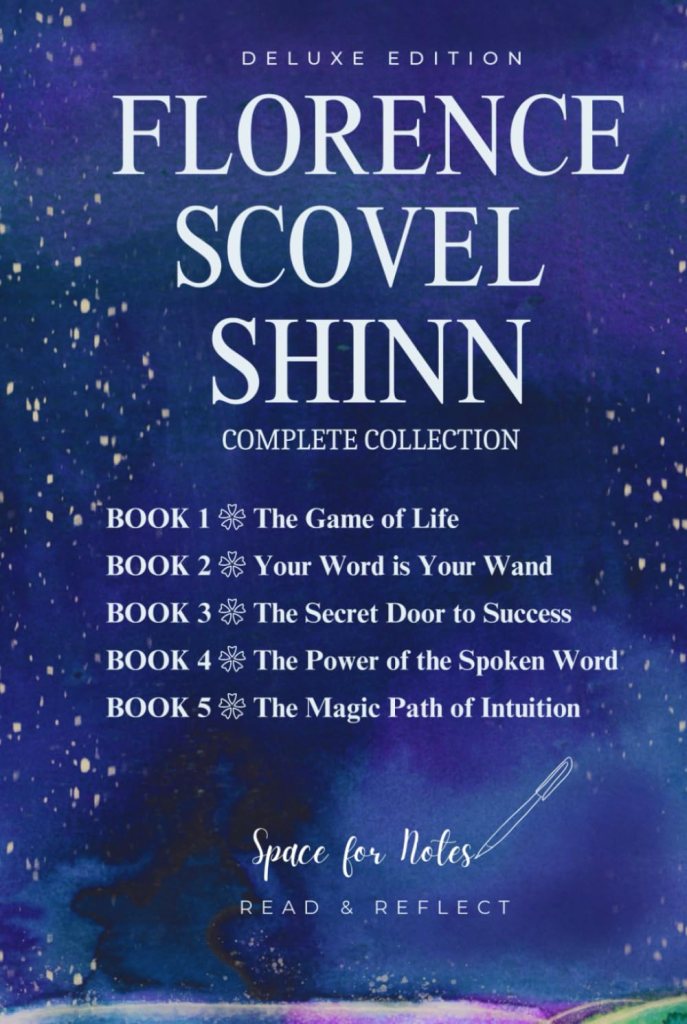
Florence Scovel Shinn Complete Collection
- The Game of Life and How to Play It
- Your Word Is Your Wand
- The Secret Door to Success
- The Power of the Spoken Word
- The Magic Path of Intuition
 Astra Aeternum X
Leave a comment